CAPÍTULO UNO
The First Impossible Letter
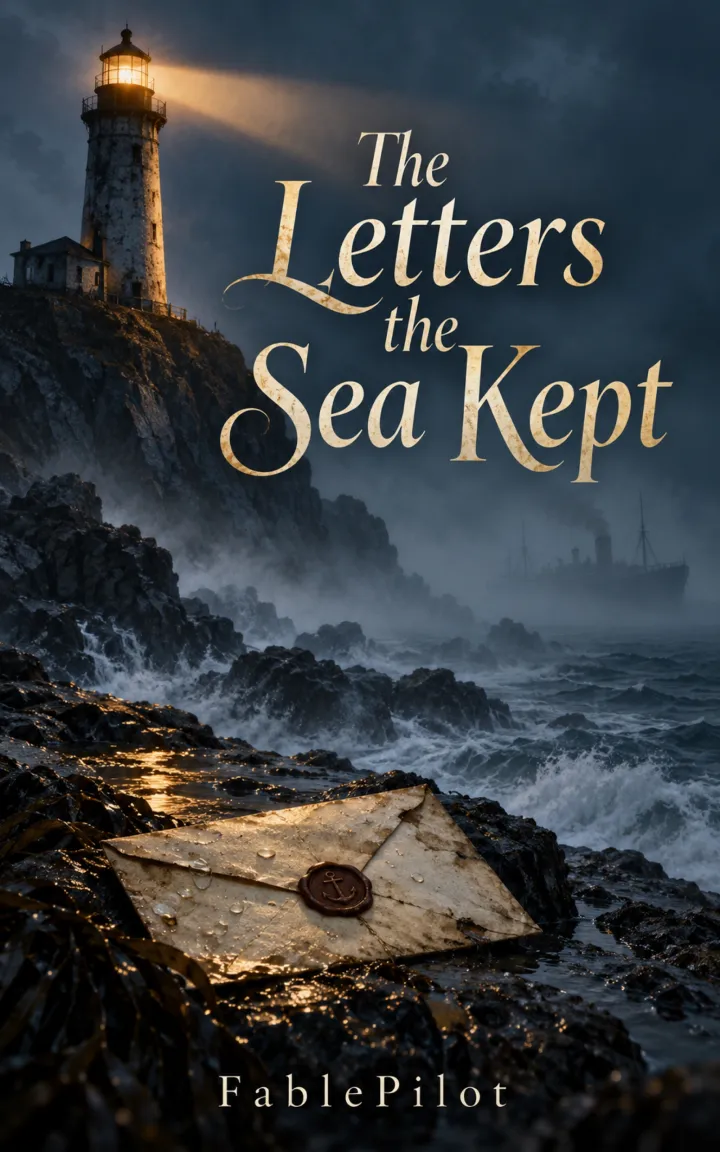
The fog came in at four, the way it always did, and with it came the letter.
Elias found it wedged beneath the lamp-room door, the envelope still damp, addressed to a man who had been dead for forty years.
He did not open it at once. He made tea. He wound the clock. He told himself the sea keeps nothing it means to return.
By the time the lamp was lit, the fog had pressed its face against every window, and the letter lay on the table like a held breath.
The lighthouse had been replaced six years earlier by an automatic beacon farther up the headland, but Elias kept its old lamp working. His right to occupy the keeper’s rooms expired that Friday. Brass seized. Gears rusted. A room built for light should not be left dark.
He sat opposite the envelope.
Mr Thomas Vale
Bellwether Lighthouse
Rookhaven
Thomas had vanished aboard the Marigold in 1946. His name stood on the memorial stone below Captain Arthur Bell’s. Forty years was long enough for a man to become a story other people told badly.
Elias opened the letter.
The hand slanted uphill, impatient as ever. The capital T bore its long, savage crossbar.
Little lampman—
His fingers tightened on the paper.
Thomas had called him that when they were boys: little lampman, mind the flame; little lampman, you’ll burn the shed down. Their mother had hated it. Thomas had treasured anything that annoyed her.
If this reaches you, then the old arrangements have held.
Do not trust dates. Find what Mother put where the light could not reach. You remember the place, though you pretended not to see it.
The night the Marigold took the north channel was not as they said.
Forgive me, if you can manage it.
A. Bell
Elias read the signature twice.
Arthur Bell had captained the Marigold. Bell had died with the ship, or near enough; there had been a coat, a ring, a watch for his widow. Whoever wrote this knew Thomas’s private name for Elias and had signed himself with a dead captain’s name.
“Rubbish,” Elias said.
The fog gave no opinion.
There was no stamp or postmark. The envelope had been pushed beneath the lamp-room door, three flights above ground. Its dampness smelled faintly of brine.
What Mother put where the light could not reach.
Nell had been dead eleven years. She had kept Thomas’s few possessions in a biscuit tin and locked every cupboard in the cottage. Elias had cleared the place after her funeral. He had found nothing except unpaid gas bills and a photograph of Thomas in his wireless uniform.
Still, he fetched his screwdriver.
The lower service cupboard stood on the half-landing, painted shut since the old coal furnace had been removed. Elias worked the screws loose. Behind the latch plate, in a hollow cut into the stone, lay a bundle of oilcloth tied with red thread.
Inside was a brass key stamped with a 4, and a torn corner of a tide table.
On the back, in Nell’s brisk hand, were the words:
The cellar first, Eli. Use a current tide table if Tom sends you farther.
Elias closed his fist around the key.
Three hard knocks struck the outer door.
He went down, pocketing the key and letter. Fog whitened the stairwell window. Mara Quinn stood under the porch lamp, collar raised against the wet. She was the archivist from town, sharp-eyed and inconveniently young. Last spring, she had corrected two dates in his old logbooks.
“Mr Vale,” she said. “I’m sorry to call.”
“It’s foggy.”
“Yes.”
“Not a night for this path.”
“I had a reason.” She held up a wet-edged envelope bearing the Marigold’s faded crest. “May I come in?”
He stepped aside.
“The archive was locked,” she said. “This was in the letter slot when I opened this morning. Empty, except for your address written inside the flap.”
Elias looked at it.
“My grandfather was Patrick Quinn,” she added. “Cook on the Marigold.”
“I know.”
“Then you know why I’m here.”
“People play cruel jokes.”
“They do.” Her gaze found the letter in his hand. “But not usually such precise ones.”
The lamp mechanism hummed overhead. Its beam swept the fog beyond the glass and disappeared almost at once.
“Yours wasn’t empty,” Mara said.
“No.”
“May I see?”
“No.”
She absorbed that without offence. “Does it mention the Marigold?”
Elias should have sent her away. The matter was his: Thomas, their mother, the old wound reopened by some malicious hand. Yet Mara’s grandfather had gone down with the same ship. The memorial did not distinguish between brothers and strangers.
“There’s an old coal cellar,” he said.
“I know. It’s on the original plans.”
“Of course it is.”
“It hasn’t been opened?”
“Not in years.”
“Do you have a key?”
He showed her the brass key.
They descended past the kitchen shelves and the rusted coal scuttle he had never discarded. The cellar door waited beneath the west side of the lighthouse, its lock green with age.
Mara stood close as Elias fitted the key. Rain began ticking against the panes overhead.
“This came in the letter?” she asked.
“My mother left it.”
“That’s not the same answer.”
“No.”
The key turned once.
From the outer door at the foot of the stairs came the soft scrape of wet paper over stone.
Elias and Mara looked at one another.
A second envelope slid beneath the door.
FIN DEL CAPÍTULO UNO · 4 CAPÍTULOS MÁS EN EL LIBRO COMPLETO